

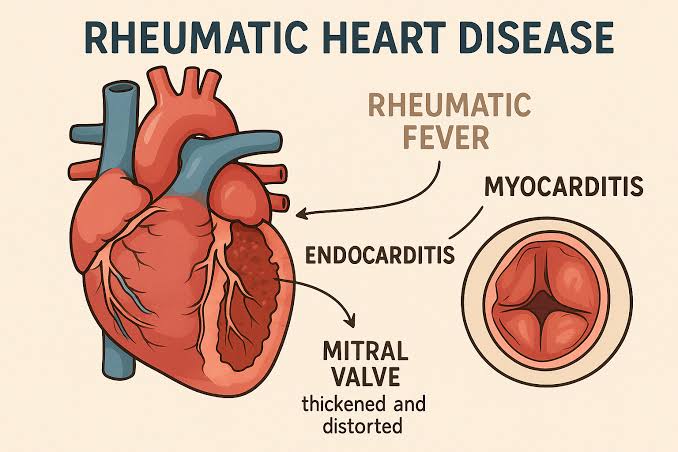
Evaluation of duration for in Patients with Rheumatic Heart Disease: A Scoping Review
Hassan Haghaninejad (haghaninejad@gmail.com), Seyedeh Mahdieh Namayandeh (drnamayandeh@gmail.com), Mohammadreza Ahi (ahi.dvm@gmail.com)
Abstract
Introduction: Rheumatic Heart Disease (RHD) is recognized as a late sequela of Acute Rheumatic Fever (ARF), resulting from an autoimmune response to Group A Streptococcus infection. This chronic disease primarily affects young populations, and penicillin-based prophylaxis remains the cornerstone of RHD management to prevent ARF recurrence and disease progression. To date, a single, comprehensive guideline for the duration of prophylactic treatment has not been established.
Methods: This structured review was conducted following the PRISMA framework. After a systematic search of PubMed, EMBASE, and the Cochrane Library followed by a two-stage screening process, 16 of the initial 121 studies met the inclusion criteria, which comprised original research with explicit duration recommendations, human subjects, and publication in English. Data extraction focused on treatment duration recommendations.
Results: Ten key factors determining the duration of prophylaxis were identified: severity of RHD, time since the last ARF attack, patient age, residence in high-risk areas, history of recurrent ARF attacks, echocardiographic findings, patient adherence levels, socio-cultural factors, healthcare system challenges, and physiological status. Comparison of international guidelines revealed significant discrepancies; Australian and New Zealand guidelines recommend a minimum of 10 years of prophylaxis for cases with a history of ARF, whereas the Indian guideline suggests a duration of 5 years for mild cases and up to 40 years of age for severe cases. The World Health Organization (WHO) prescribes 5–10 years of prophylaxis for mild to moderate cases and lifelong treatment after valve surgery, while the American Heart Association (AHA) deems 5 years necessary for mild cases and 10 years for moderate to severe cases. The primary challenges identified were determining the optimal duration of treatment in patients without a history of ARF and maintaining long-term adherence.
Conclusion: Despite the efficacy of secondary prophylaxis with intramuscular penicillin, the heterogeneity of guidelines in determining treatment duration—particularly in patients without a history of ARF—remains a major challenge. Updating guidelines by integrating advanced echocardiographic criteria and individual-environmental risk factors is essential. Future research priorities include developing personalized, risk-based protocols, conducting longitudinal studies in low-income populations, designing interventions to improve adherence, and re-evaluating lifelong therapy using modern echocardiographic classifications. The main limitation of this review was the methodological heterogeneity of the included studies and the concentration of data on high-income countries.
Keywords: Rheumatic Heart Disease, Prophylaxis, Intramuscular Penicillin, Treatment Duration, Guidelines.