
Effect of Sequential Embryo Transfer on ART Outcome of Patients with at Least Two and Maximum of Five Embryos, a Randomized Clinical Trial
Background: Assisted reproductive technology (ART), offers hope for many of infertile couples. However, the success of in vitro fertilization (IVF) hinges on various factors, with embryo transfer (ET) being a critical step influencing its outcome. The shift towards extended embryo culture and blastocyst-stage embryo transfer, has gained traction in ART practice due to potential benefits including improved implantation rates.
Objective: The aim of this study is to compare the outcomes of sequential ET versus single-step cleavage-stage ET in women undergoing fresh embryo transfer cycle with a limited number of embryos.
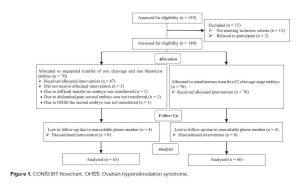
Material and Methods: This randomized clinical trial was conducted on 140 women undergoing infertility treatment and candidates for fresh embryo transfer at the infertility research and treatment center of the Yazd Reproductive Sciences Institute from August 2023 to Jnuary 2024. Women with embryo count ranging from 2 to 5 (≥2 and ≤5 available embryos) were randomly assigned to one of the study arms. One group underwent sequential ET (one cleavage-stage ET followed by one blastocyst ET) and the other group underwent single-step two cleavage-stage ET. Primary outcome is clinical pregnancy and secondary outcome includes chemical pregnancy and early abortion rates.
Results: significantly higher rates of clinical (33.5% vs. 13.6%, P value 0.003) and chemical (41.3% vs. 18.2%, P value 0.004) pregnancies in the sequential ET group compared to the single-step cleavage ET group. Early abortion rate was higher in single-step cleavage ET (13% vs. 44.4%, P value 0.053).
Conclusion: Sequential fresh ET is a useful choice in women who have limited number of embryos and can improve ART outcomes.
Key words: blastocyst transfer, in vitro fertilization, embryo transfer